.png)
Since 1946
पी0 एम0 श्री जे0 एस0 माजिला स्मारक रा0 इ0 का0 काण्डा (बागेश्वर)

- Email: gickanda@gmail.com
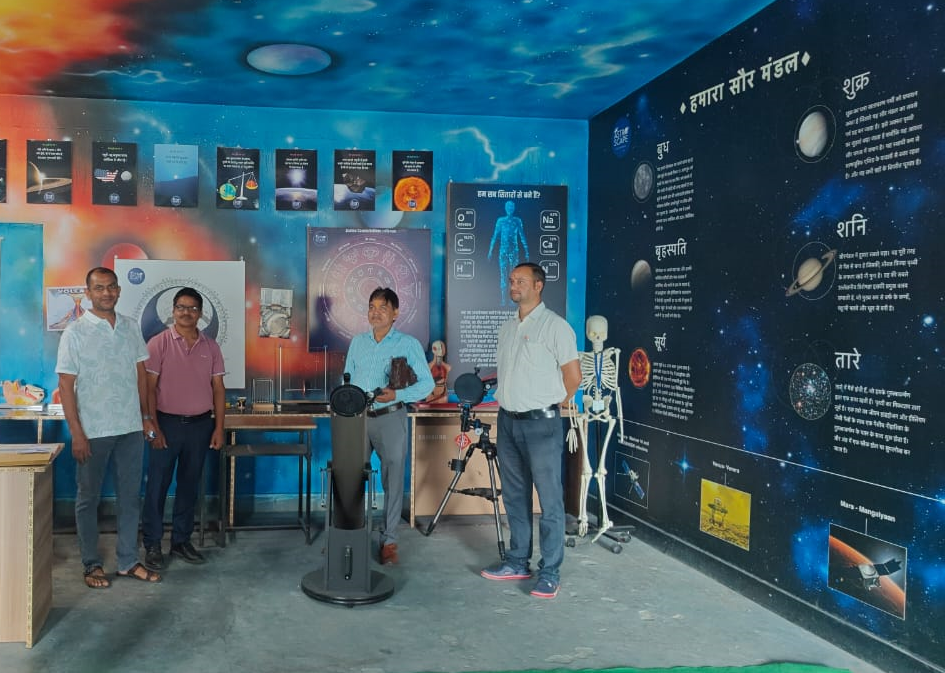
Science labs in schools are essential for providing students with practical knowledge and hands-on experience in subjects like Physics, Chemistry, and Biology. These labs help students go beyond textbooks and understand scientific concepts through experiments, observations, and analysis.
The physics lab allows students to explore the principles of motion, light, sound, electricity, and magnetism. With instruments like lenses, prisms, circuits, and pendulums, students can conduct experiments that strengthen their understanding of physical laws and theories.
In the chemistry lab, students learn about elements, compounds, and chemical reactions. The lab is equipped with test tubes, beakers, burners, and safety tools, enabling students to carry out experiments such as titrations, preparation of solutions, and study of chemical properties. Safety is a priority, and proper guidelines are always followed.
The biology lab provides students with the opportunity to study life sciences in detail. It includes microscopes, slides, specimens, and models of organs and organisms. Here, students learn about cell structures, anatomy, genetics, and ecological systems through direct observation and experimentation.